
Description
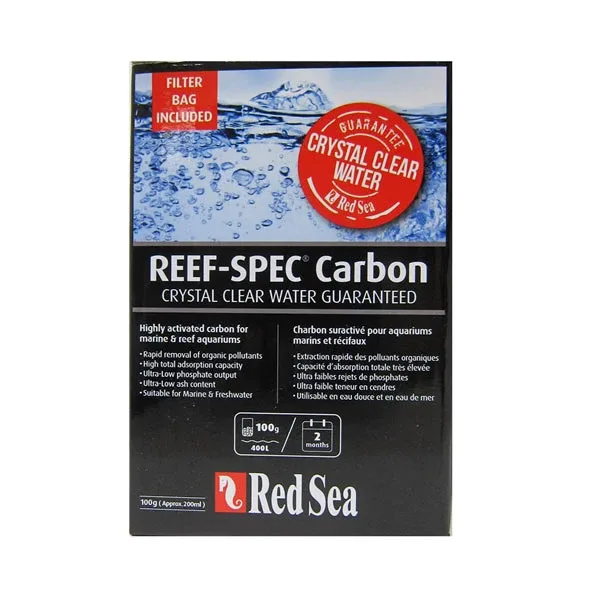
REEF-SPEC Carbon Highly activated carbon for marine & reef aquariums Red Sea REEF-SPEC™ Carbon is the ultimate choice for marine & reef aquariums due to its unique technical characteristics. Red Sea REEF-SPEC™Carbon’s granule size and its micro/macro porous structure, ensures a very high total adsorption capacity and rapid extraction of the specific organic pollutants that are found in Reef aquariums. REEF-SPEC™ Carbon has extremely low phosphate leaching and minimal ash content while also not affecting the pH of aquarium water. Red Sea REEF-SPEC™ Carbon needs replacing less frequently than carbons that are not reef-specific or are of a lower quality and represents an effective, cost-efficient solution for providing the very best water quality in marine & reef aquariums. Main features: Rapid removal of organic pollutants High total adsorption capacity Ultra-Low phosphate output Ultra-Low ash content Suitable for Marine & Freshwater Filter Bag included( 250gr, 500gr) REEF-SPEC™ Carbon is available in 250g /9 oz , 500g /18 oz and 1000g /35 oz containers. The role of Activated Carbon in the reef aquarium Why do we need to use carbon in a reef aquarium? There are organic pollutants that can only be removed from reef aquarium water by active carbon. The reef aquarium is a closed artificial ecosystem where living creatures continually produce organic waste consisting of proteins, fats, carbohydrates, organic acids and phenols. If allowed to decompose the organics will fuel the activity of many unwanted microorganisms in the aquarium, increasing the total oxygen demand (BOD, COD) which will cause a reduction in Redox potential, as well as causing excessive production of CO2 by bacterial respiration, which will reduce pH. Furthermore, there will be an increase in nitrogenous and phosphorus compounds, encouraging growth of nuisance bacteria and eventually of nuisance algae. The accumulating organics also has a significant effect on light penetration, especially in the blue and near UV spectrum that stimulates coral growth. Stripping out the organics from the water is therefore crucial for the success of the aquarium. Using strong protein skimming, fine mechanical filtration and healthy biological filtration (nitrification and de-nitrification) will treat the large organic particles and the end products of the organic decomposition processes. However, there are many small organic particles that can only be treated by very fine mechanical micro-filtration using activated carbon. How does activated carbon filter water? Scientifically speaking, carbon removes the organics from water by a physical process called adsorption. Within a reef aquarium, the submicroscopic pores of activated carbon is the final stage of the mechanical filtration process, adsorbing the organic molecules that are too small to be removed by even the finest mechanical filters or physically removed from the water by protein skimming. Adsorption can be thought of as the adhesion of a molecule to surface by attractive forces. This occurs within the submicroscopic pores of the carbon because the attractive forces between the organic molecules and the internal surfaces of the carbon are far greater than the attractive forces that keep them dissolved in solution. This will continue until all of the surface area inside the carbon is used up and it becomes saturated with organics. What is activated carbon? Activated carbon is an extremely porous material with a sponge like structure but with a very large internal surface area relative to its physical size. It is produced from many organic materials that have a high carbon content such as coconuts shells, nutshells, lignite, bituminous coal or anthracite. The carbon-based material is “activated” through physical modification and thermal decomposition in a furnace, under a controlled atmosphere and temperature. The activation process significantly increases the surface area per unit volume of a fine network of submicroscopic pores which is what gives activated carbon its ability to act as a filter material. The specific source of the carbon and the specific activation process determines the physical characteristics of the finished product. There are many different grades of activated carbon and therefore they must be selected specifically for each and every application. What makes a specific carbon ideal for reef aquariums usage? There are a number of internationally accepted tests for evaluating and comparing activated carbon. However, the most significant parameters for selecting a carbon for reef aquariums are the Iodine Number and Methylene Blue Number. These two parameters measure the ability of the carbon to adsorb all of the organic waste from a reef aquarium that is not removed by the mechanical filtration and protein skimming. The higher the number the more organics will be removed from the aqu…