
Description
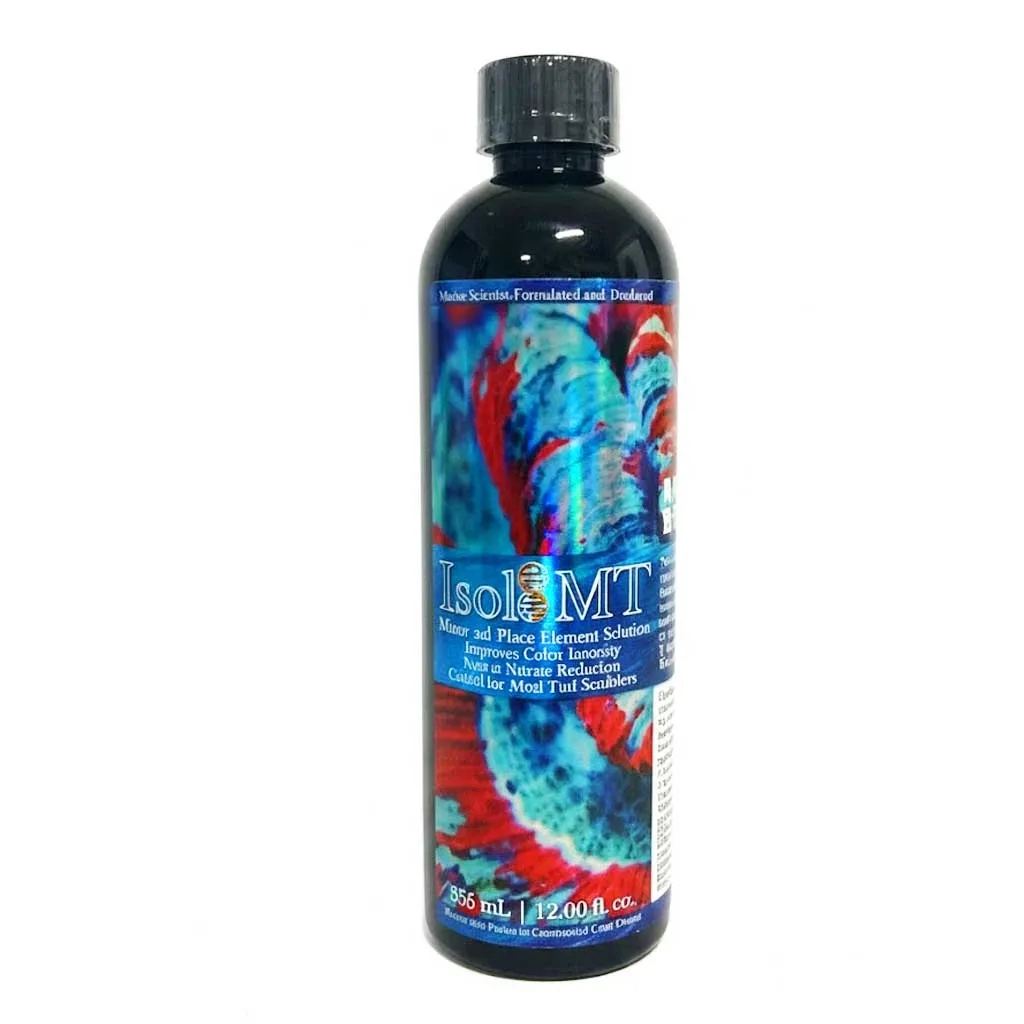
Parameter Value Iodide 52,840 ppm Molybdenum 9,983 ppm Nickel 444.300 ppm Zinc 371.400 ppm Manganese 259.900 ppm Copper 240.500 ppm Selenium 127.000 ppm Vanadium 110.400 ppm Iron 52.850 ppm Cobalt 1.673 ppm Characteristics Provides specific minor and trace elements required by photoautotrophs (including zooxanthellae) for critical cellular functions, including: nitrogen assimilation and nitrate reduction; cell division; CO2 fixation; phosphorus acquisition; production of pigments, vitamins, and enzymes; DNA transcription. Critical for photosynthetic processes and nutrient reduction in systems employing algal turf scrubber filtration. Improves color intensity of zooxanthellate invertebrates. Aids in the reduction of nitrate. Excludes Lanthanides, Chromium, Barium, Fluoride, and Iodine. Active Components: USP-grade: Potassium iodide; Sodium metavanadate; Nickel chloride; Zinc chloride; Manganese chloride; Copper sulfate; Sodium selenite; Sodium metavanadate; Iron chelate (proprietary form); Cobalt chloride. Basic Application Days 1 – 10: 1 drop (0.05 mL) per 25 gal. x 24 h. Thereafter: Modify dosing as dictated by change in nutrient density and ICP analysis (see below). Discussion Photoautotrophs, including endosymbiotic eukaryotes, utilize specific minor and trace elements during the course of various cellular functions, including, but not limited to: cell division; nitrogen uptake (nitrogen assimilation, nitrate reduction); CO2 fixation; phosphorus acquisition; photosynthesis; production of pigments and vitamins; DNA transcription. The rate of phototroph-driven element depletion within a recirculating system is mediated by photoperiod length and rate of nutrient input, among other chemical and physical factors. Failure to maintain adequate availability of these critical elements suppresses the rate of nutrient uptake, feasibly resulting in nutrient accumulation within the system and, potentially, cell death within the photoautotroph population. Many complex reactions taking place within plant and algal cells require the presence of multiple elements to achieve completion. Absence of any one of the critical elements therefore inhibits productivity. Elements provided by this formulation: have been long-established by researchers as being critical to photosynthesis; are present in appropriate ratios; dosed as directed, will not cause suppression of photoautotroph cellular production as a result of accumulation. This formulation does not propose to act as a complete growth medium for diatom cultures, and therefore omits silicon as a component. Supplementation of minor and/or trace elements known to suppress the growth of photoautotrophs is contraindicated in systems housing cohorts partially- or wholly-reliant upon nutrient production by endosymbiotic eukaryotes for long-term existence. Evidence suggests that presence of Lanthanides, in addition to specific heavy metals (e.g. Hg, Pb, As, Cd, Cr), inhibits growth of photoautotroph cultures. These elements are omitted from this formulation. Application Keep out of reach of children and unauthorized persons. Avoid contact with skin, eyes, and mucous membranes. Store in a cool, dry location away from sunlight. The rate of ion depletion due to photoautotroph uptake is driven by various chemical and physical factors which are unique to each independently-operating recirculating system, and which are constantly changing as photoautotroph biomass increases and decreases. Monitoring (daily) the system’s concentrations of elements provided by this formulation, as well as the concentration of nitrate, and referencing apparent changes in coloration of zooxanthellate cnidarians will enable User to adjust dosing of this formula to suit system requirements, improving overall effectiveness and resulting in less wasted solution. Users unable to perform analyses for elements provided by this formula are recommended to monitor nitrate concentration and apparent changes in coloration of zooxanthellate cnidarians, adjusting dosage to suit system requirements. This visual approach to dosing is fastest, and for many systems will be adequate. Recommended is diluting an appropriate volume of this solution into a larger volume of purified water (with a purity of at least 98%), and applying this diluted solution to the system with an automated dosing system throughout the photoperiod. Dosing frequency is directly proportional to stability of ionic concentrations and, resultantly, gradual changes in the coloration (manifesting as intensification) of coloration of zooxanthellate cnidarians. A 1 – 10 s drip interval during the photoperiod provides adequate ionic stability, and is recommended. If no automated dosing system is available, then apply solution manually each day. Dosing frequency is direct…